The extreme Universe viewed in very-high-energy gamma rays 2025

Asia/Tokyo
Description

宇宙線研究所共同利用研究会・基盤研究(S)研究会
「高エネルギーガンマ線でみる極限宇宙2025」

共催 : 東京大学次世代ニュートリノ科学・マルチメッセンジャー天文学連携研究機構

"The extreme Universe viewed in very-high-energy gamma rays 2025"

co-organised with the Next-generation Neutrino Science and Multi-messenger Astronomy Organization (NNSO)

(Please see below for the English version.)

来週2026年2月3日(火) と4日(水) に開催される
研究会「高エネルギーガンマ線でみる極限宇宙2025」の最終プログラムをお知らせいたします。
https://indico.icrr.u-tokyo.ac.jp/event/1199/program
(プログラムは、 English versionの最後にも掲載しています。)

1月31日(土)正午までは、参加のみ登録可能となっております。
https://indico.icrr.u-tokyo.ac.jp/event/1199/registrations/

なお、すでにご登録頂いたオンライン参加の方のZoomの接続先は、
1月31日(土)夕方にはお知らせする予定です。

皆様のご参加をお待ちしております。
                                       CTAO-Japan一同
------------------------------------------------------------------------
宇宙線研究所共同利用研究会・基盤研究(S)研究会
「高エネルギーガンマ線でみる極限宇宙2025」
"The extreme Universe viewed in very-high-energy gamma rays 2025"
共催 : 東京大学次世代ニュートリノ科学・マルチメッセンジャー天文学連携研究機構

開催日時:
2026年2月3日(火) 日本時間10:00 - 10:25(現地参加者受付)
                                  10:25 - 17:45
2026年2月4日(水) 日本時間  9:30 - 16:55
※時間帯は多少変更される場合があります。


研究会URL:https://indico.icrr.u-tokyo.ac.jp/e/workshopCTAJ2025


研究会会場(ハイブリッド): 東京大学柏キャンパス 図書館メディアホール / オンライン(Zoom)

図書館メディアホール
http://www.u-tokyo.ac.jp/campusmap/cam03_04_04_j.html

東京大学柏キャンパスへのアクセス
http://www.icrr.u-tokyo.ac.jp/access/index.html

招待講演者(敬称略):
阿部 正太郎(東大宇宙線研): LST Galactic Center
赤堀 卓也(国立天文台) : SKAO
Joshua Ryo Baxter (ICRR) : LST AGN & EBL
林 航平(仙台高専) : Dark Matter Astrophysics
岩切 渉(千葉大) : MAXI+IceCube
岩田 悠平(国立天文台) : SKAO Radio Transient
Dmitry Khangulyan (IHEP) : LHAASO & Microquasar
小林 志鳳(千葉大) : IceCube
志達 めぐみ(愛媛大) : XRISM Microquasar
身内 賢太朗(神戸大) : Dark Matter Direct Search
酒見 はる香(山口大) : SKAO Microquasar
さこ 隆志(東大宇宙線研): Tibet/ALPACA
戸谷 友則(東京大) : Dark Matter Indirect
Ievgen Vovk (ICRR, Univ. of Tokyo) : CTAO-LST
-------------

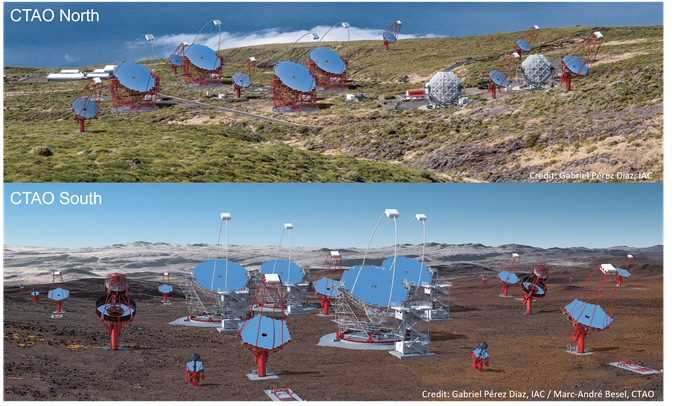
趣旨: Cherenkov Telescope Array Observatory (CTAO) 計画は、大口径(23 m)・中口径(12 m)・小口径(4 m) の3種類の望遠鏡群を配置して、従来より10 倍の高感度と、かつてない広いエネルギー領域(20 GeV から300 TeV) のガンマ線で、極限宇宙の精密測定を行うことを目指す国際共同プロジェクトです。CTAO計画が実現すれば、約1000個の天体からTeVガンマ線が検出できると予想され、パルサー/パルサー星雲、超新星残骸、活動銀河核などの高エネルギー天体での宇宙線加速と伝播過程の解明、銀河形成史や宇宙論、さらにはダークマターの探索、原始ブラックホール探索、ローレンツ不変性の検証などの基礎物理など多岐にわたるサイエンスが可能となります。

日本は、2009年に CTAO-Japan コンソーシアム(https://www.cta-observatory.jp/)を結成しCTAOに正式メンバーとして参加をはたし、130名近くを越えるメンバーが準備研究を推進してきました。2018年10月に、北サイトのカナリー諸島ラ パルマで、日本が大きく貢献してきた大口径望遠鏡初号機(LST-1)が完成し、2019年11月にはかに星雲からのガンマ線、2020年1月から2月にはかにパルサーからのガンマ線の信号検出にも成功しました。現在も、LST-1の低エネルギー閾値を活かし、活動銀河核(赤方偏移~1のFSRQ OP 313も含む)、史上最も明るいガンマ線バースト、銀河中心領域、ゲミンガパルサー、再帰新星RS Ophiuchiなどの検出に成功し、順調に運用を進めています。さらに、現在は大口径望遠鏡2-4号基の鏡の設置が完了し、2026年にはLST複数台でのステレオ観測を目指しています。また、南サイトのチリ・パラナルでのインフラ整備も進行しており、大・中・小口径望遠鏡の開発が進められています。

今後、CTAO時代を迎え、TeVガンマ線天文学がさらに他波長の電磁波観測や、高エネルギーニュートリノ、重力波観測との連携を深め、時間領域天文学、マルチメッセンジャー天文学の一翼を担っていくためにも、研究会を通じて広い分野の研究者と議論を深め、今後の戦略を練り、様々な角度から議論するコミュニティーに開かれたものとして開催いたします。また、基盤研究(S)(2023年度-2027年度)「CTA大口径ガンマ線望遠鏡で解き明かす高エネルギー激動宇宙と暗黒物質」として推進されているサイエンスや望遠鏡の開発状況の報告も含まれますので、この分野に興味もある方の多くのご参加をお待ちしています。

世話人:井岡 邦仁(YITP)、窪 秀利(ICRR)、野崎 誠也(ICRR)、
    野田 浩司(千葉大学)、齋藤 隆之(ICRR)、田島 宏康(名大ISEE)、
    辻 直美(ICRR)、手嶋 政廣(ICRR & MPI)、戸谷 友則(東京大学)、
    山本 常夏(甲南大学)、吉越 貴紀(ICRR)、吉田 龍生(茨城大学)


=====(English version)======

Dear all,

Thank you very much for your registration.
Here is the final program of the CTAO-Japan workshop.
https://indico.icrr.u-tokyo.ac.jp/event/1199/program
(The program is also available at the end of this email.)

If you have not yet registered and would like to participate, please register at Registration on the following page. Applications for travel expenses are now closed.
https://indico.icrr.u-tokyo.ac.jp/event/1199/registrations/
The deadline for registration is Saturday, January 31.

For the online participants: The Zoom connection will be provided on Saturday, January 31.

We look forward to seeing you at the workshop.

Best regards,
Tatsuo Yoshida on the behalf of the SOC
--------------------------


Workshop: "The extreme Universe viewed in very-high-energy gamma rays 2025"

co-organised
with the Next-generation Neutrino Science
and Multi-messengerAstronomy Organization (NNSO)

Date:
1st day: 3 February, 2026
                JST  10:00 - 10:25 Registration for in-person participants
                         10:25- 17:45                   
2nd day: 4 February, 2026
                JST   9:30 - 16:55

Venue(hybrid):
The Media Hall of the Kashiwa Library in the Kashiwa Campus, the University of Tokyo
/ Online (Zoom)

Access:
http://www.u-tokyo.ac.jp/content/400020147.pdf #2 Kashiwa Library
https://www.u-tokyo.ac.jp/en/index.html#map #Kashiwa Campus

Outline:
The construction of Cherenkov Telescope Array Observatory (CTAO)-North Large-Sized Telescope 1(LST-1) was completed in 2018, at the Observatorio del Roque de los Muchachos site in La Palma. The critical design review of the LST-1 was successfully approved in 2024. The remaining three Large-Sized Telescopes (LST-2-4) are currently under construction and will be completed in 2026, aiming for stereo observations with 4 LSTs. In addition, infrastructure development of the CTAO South site is progressing in Chile, Paranal, and development of Large-Sized, Medium-Sized, and Small-Sized telescopes are underway.

The commissioning phase of CTAO-North LST-1 is currently progressing well. The LST-1 detected the gamma-ray signal from the Crab Nebula in November 2019 and successively detected the pulsed gamma-ray emission from the Crab pulsar in January-February 2020.
Currently, thanks to the low energy threshold of LST-1, we have successfully detected AGNs (including FSRQ OP 313 at redshift ~1), the BOAT GRB, Galactic Center regions, the Geminga pulsar, and the recurrent nova RS Ophiuchi.

The CTA Observatory will play important parts in multi-messenger astronomy with a global network of gravitational wave detectors, the high-energy neutrino observatory, and other wavelength observations. In this workshop we will view the extreme Universe from observational and theoretical aspects and focus on the science targeted by the CTAO LSTs, namely GRBs, AGNs, Pulsars, Starburst Galaxies, Dark Matter searches, Primordial Black Hole searches, and test of Lorentz Invariance Violation.

This workshop is supported by the joint research program of the Institute for Cosmic Ray Research (ICRR), the University of Tokyo and JSPS KAKENHI Grant-in-Aid for Scientific Research (S), Number 23H05430 "Revealing the high-energy dynamic universe and dark matter with the CTA large-aperture gamma-ray telescopes".

Invited Speakers :
Shotaro Abe (ICRR) : LST Galactic Center
Takuya Akahori (NAOJ) : SKAO
Joshua Ryo Baxter (ICRR) : LST AGN & EBL
Kohei Hayashi (NIT, Sendai College) : Dark Matter Astrophysics
Wataru Iwakiri (Chiba Univ.) : MAXI+IceCube
Yuhei Iwata (NAOJ) : SKAO Radio Transient
Dmitry Khangulyan (IHEP) : LHAASO & Microquasar
Yukiho Kobayashi (Chiba Univ.) : IceCube
Shidatsu Megumi (Ehime Univ.) : XRISM Microquasar
Kentaro Miuchi (Kobe Univ.) : Dark Matter Direct Search
Haruka Sakemi (Yamaguchi Univ.) : SKAO Microquasar
Takashi Sako(ICRR) : Tibet/ALPACA
Tomonori Totani (Univ. of Tokyo) : Dark Matter Indirect
Ievgen Vovk (ICRR, Univ. of Tokyo) : CTAO-LST

Registration:
We would kindly ask you to register if you intend to participate. Please do so here:
https://indico.icrr.u-tokyo.ac.jp/event/1199/registrations/

Registration deadline: 31 Januaray, 2026

SOC:
Kunihito Ioka (YITP), Hidetoshi Kubo (ICRR),
Seiya Nozaki(ICRR), Koji Noda (Chiba Univ.),
Takayuki Saito (ICRR), Hiroyasu Tajima (ISEE, Nagoya Univ.),
Naomi Tsuji (ICRR), Masahiro Teshima (ICRR & MPI),
Tomonori Totani (Univ. of Tokyo), Tokonatsu Yamamoto (Konan Univ.),
Takanori Yoshikoshi (ICRR), Tatsuo Yoshida (Ibaraki Univ.)
==========
Program:

*** invited talks 35+5
**  invited talks 30+5
*   PhD thesis   25+5
    contributed   20+5

===JST 10:00 - 17:45 Tuesday, Feb. 3, 2026===
10:00 - 10:25 Registration for in-person participants
10:25 - 10:30 Opening

Session 1: Very-High-Energy Gamma-Ray Astrophysics (1)
10:30 - 11:05 (30+5)**
                    "Large-Sized Telescope array for CTAO: status and first results"
                    Ievgen Vovk (ICRR, Univ. of Tokyo)

11:05 - 11:45 (35+5)***
                    "Revealing the most extreme Galactic sources with LHAASO"
                    Dmitry Khangulyan (IHEP, CAS)

11:45 - 12:50 (65) Lunch

Session 2: Microquasars and Particle Acceleration
12:50 - 13:25 (30+5)**
                    "XRISM Views of Microquasars"
                    Megumi Shidatsu (Ehime Univ.)

13:25 - 13:50 (20+5) [online]
                    "HAWC Gamma-Ray and radio observations of the microquasar V4641 Sgr"
                    Eduardo de la Fuente Acosta (Univ. of Guadalajara)

13:50 - 14:25 (30+5)** [online]
                    "Cosmic-Ray Particle Acceleration
                    by Microquasars Revealed with the Square Kilometre Array"
                    Haruka Sakemi (Yamaguchi Univ.)

Session 3: Very-High-Energy Gamma-Ray Astrophysics (2)
14:25 - 15:00 (30+5)**
                    "Sub-PeV gamma-ray observations of the northern and southern skies
                    by the Tibet and ALPACA experiments"
                    Takashi Sako (ICRR, Univ. of Tokyo)

15:00- 15:30 (30) Group photos + Coffee Break

Session 4: Contributed Talks (1)
15:30- 15:55 (20+5)
                    "The role of TeV-PeV cosmic rays in the Milky Way and beyond"
                    Susumu Inoue (Chiba Univ.)
15:55- 16:20 (20+5)
                    "A common four-beam geometry reveals altitude-stratified GeV pulses
                    in canonical young pulsars"
                    Kin Hang (Paul) Yeung (ICRR, Univ. of Tokyo)

16:20- 16:45 (20+5)
                    "Constrain the Disk-corona Geometry of Stellar Mass Black Hole Cyg X-1
                    with X-ray Spectral-polarimetric Observations"
                    Sixuan Zhang (Hiroshima Univ.)

16:45- 17:10 (20+5)
                    "High energy gamma-ray emission from globular cluster populations in galaxies"
                    Ellis Owen (RIKEN)

Session 5: Dark Matter (1)
17:10 - 17:45 (30+5)**
                    "The 20 GeV Fermi halo: Evidence for dark matter annihilation?"
                    Tomonori Totani (Univ. of Tokyo)

18:00 - 20:00 Banquet

===JST 9:30 - 16:55 Wednesday, Feb. 4, 2026==

Session 6: PhD theses
 9:30 - 10:00 (25+5)*
                    "TeV Gamma-Ray Emission across the Galactic Center Ridge with the CTAO LST-1"
                    Shotaro Abe (ICRR, Univ. of Tokyo)

10:00 - 10:30 (25+5)*[online]
                    "AGN observations with the LST-1 and new constraints on the EBL intensity"
                    Joshua Ryo Baxter (Clemson Univ.)

Session 7: Contributed Talks (2)
10:30 - 10:55 (20+5)
                    "ALMA Calibrator Science for CTAO:
                    Hidden Galactic Clouds and a Millimeter View of Gamma-ray Blazars"
                    Kanako Narita (Univ. of Tokyo)

10:55 - 11:20 (20+5)
                    "High-redshift intergalactic magnetic field lower limits"
                    Ievgen Vovk (ICRR, Univ. of Tokyo)

11:20- 11:45 (20+5)
                    "Galaxy Clusters in GeV/TeV"
                    Olaf Reimer (Institute for Astro- and Particle Physics, Innsbruck Univ.)

11:45 - 12:55 (70) Lunch

Session 8: Dark Matter (2)
12:55 - 13:30 (30+5)**
                    "Dark Matter Direct Searches"
                    Kentaro Miuchi (Kobe Univ.)

13:30 - 14:05 (30+5)**
                    "Probing Dark Matter with the Milky Way and Its Satellite Galaxies"
                    Kohei Hayashi (NIT, Sendai College)

Session 9: Multimessenger Astrophysics : SKA
14:05 - 14:40 (30+5)**
                    "Overview of SKAO and Collaboration with CTAO"
                    Takuya Akahori (Mizusawa VLBI Observatory, NAOJ)

14:40 - 15:10 (30) Coffee Break

15:10 - 15:45 (30+5)**
                    "Radio Transient Studies in the (Pre-)SKA Era and Synergies with CTA"
                    Yuhei Iwata (NAOJ)

Session 10: Multimessenger Astrophysics : IceCube
15:45 - 16:20 (30+5)**
                    "Recent IceCube Highlights and Prospects with IceCube Upgrade"
                    Yukiho Kobayashi (ICEHAP, Chiba Univ.)

16:20 - 16:55 (30+5)**
                    "Soft X-ray transients monitored by MAXI"
                    Wataru Iwakiri (ICEHAP, Chiba Univ.)
-----------------------------------------------------------------------------------------------------------------------------------------------------------

   
  • Tuesday, 3 February
    • 10:00 10:25
      Registration for in-person participants 25m
    • 10:25 10:30
      Opening 5m
    • 10:30 11:45
      Session 1: Very-High-Energy Gamma-Ray Astrophysics (1)
      • 10:30
        Large-Sized Telescope array for CTAO: status and first results 35m
        Speaker: Ievgen Vovk ( ICRR, Univ. of Tokyo)
      • 11:05
        Revealing the most extreme Galactic sources with LHAASO 40m
        Speaker: Dmitry Khangulyan (ICRR)
    • 11:45 12:50
      Lunch 1h 5m
    • 12:50 14:25
      Session 2: Microquasars and Particle Acceleration
      • 12:50
        XRISM Views of Microquasars 35m
        Speaker: Megumi Shidatsu
      • 13:25
        HAWC Gamma-Ray and radio observations of the microquasar V4641 Sgr 25m
        Speaker: Eduardo de la Fuente Acosta (Universidad de Guadalajara)
      • 13:50
        Cosmic-Ray Particle Acceleration by Microquasars Revealed with the Square Kilometre Array 35m
        Speaker: Haruka Sakemi
    • 14:25 15:00
      Session 3: Very-High-Energy Gamma-Ray Astrophysics (2)
      • 14:25
        Sub-PeV gamma-ray observations of the northern and southern skies by the Tibet and ALPACA experiments 35m
        Speaker: Takashi Sako
    • 15:00 15:30
      Group photos + Coffee Break 30m
    • 15:30 17:10
      Session 4: Contributed Talks (1)
      • 15:30
        The role of TeV-PeV cosmic rays in the Milky Way and beyond 25m
        Speaker: Susumu Inoue (Chiba Univ. / ICRR, Univ. of Tokyo)
      • 15:55
        A common four-beam geometry reveals altitude-stratified GeV pulses in canonical young pulsars 25m
        Speaker: Kin Hang (Paul) Yeung (ICRR, Univ. of Tokyo)
      • 16:20
        Constrain the Disk-corona Geometry of Stellar Mass Black Hole Cyg X-1 with X-ray Spectral-polarimetric Observations 25m
        Speaker: Sixuan Zhang
      • 16:45
        High energy gamma-ray emission from globular cluster populations in galaxies 25m
        Speaker: Ellis Owen
    • 17:10 17:45
      Session 5: Dark Matter (1)
      • 17:10
        The 20 GeV Fermi halo: Evidence for dark matter annihilation? 35m
        Speaker: Tomonori Totani
  • Wednesday, 4 February
    • 09:30 10:30
      Session 6: PhD theses
      • 09:30
        TeV Gamma-Ray Emission across the Galactic Center Ridge with the CTAO LST-1 30m
        Speaker: Shotaro Abe
      • 10:00
        AGN observations with the LST-1 and new constraints on the EBL intensity 30m
        Speaker: Joshua Baxter
    • 10:30 11:45
      Session 7: Contributed Talks (2)
      • 10:30
        ALMA Calibrator Science for CTAO: Hidden Galactic Clouds and a Millimeter View of Gamma-ray Blazars 25m
        Speaker: Kanako Narita
      • 10:55
        High-redshift intergalactic magnetic field lower limits 25m
        Speaker: Ievgen Vovk ( ICRR, Univ. of Tokyo)
      • 11:20
        Galaxy Clusters in GeV/TeV 25m
        Speaker: Olaf Reimer (Innsbruck University)
    • 11:45 12:55
      Lunch 1h 10m
    • 12:55 14:05
      Session 8: Dark Matter (2)
      • 12:55
        Dark Matter Direct Searches 35m
        Speaker: Kentaro Miuchi (Kobe University)
      • 13:30
        Probing Dark Matter with the Milky Way and Its Satellite Galaxies 35m
        Speaker: Kohei Hayash
    • 14:05 14:40
      Session 9-1: Multimessenger Astrophysics : SKA
      • 14:05
        Overview of SKAO and Collaboration with CTAO 35m
        Speaker: Takuya Akahori
    • 14:40 15:10
      Coffee Break 30m
    • 15:10 15:45
      Session 9-2: Multimessenger Astrophysics : SKA
      • 15:10
        Radio Transient Studies in the (Pre-)SKA Era and Synergies with CTA 35m
        Speaker: Yuhei Iwata
    • 15:45 16:55
      Session 10: Multimessenger Astrophysics : IceCube
      • 15:45
        Recent IceCube Highlights and Prospects with IceCube Upgrade 35m
        Speaker: Yukiho Kobayashi (Institute for Cosmic Ray Research, The University of Tokyo)
      • 16:20
        Soft X-ray transients monitored by MAXI 35m
        Speaker: Wataru Iwakiri