ICRR young researchers' workshop

Asia/Tokyo
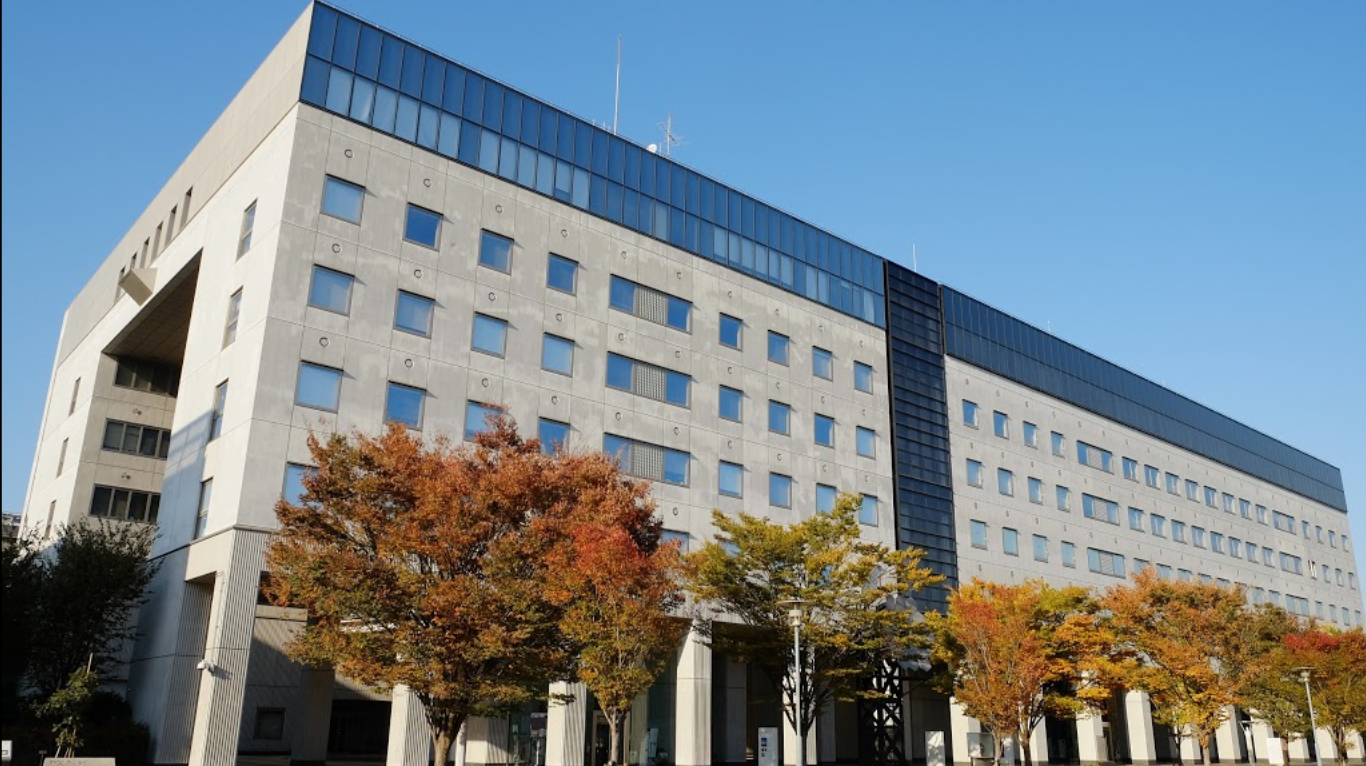
Large Seminar Room 601 (Kashiwa) (Kashiwa)

Large Seminar Room 601 (Kashiwa)

Kashiwa

277-0882, 5-1-5, Kashiwanoha, Kashiwa, Chiba, Japan
Description

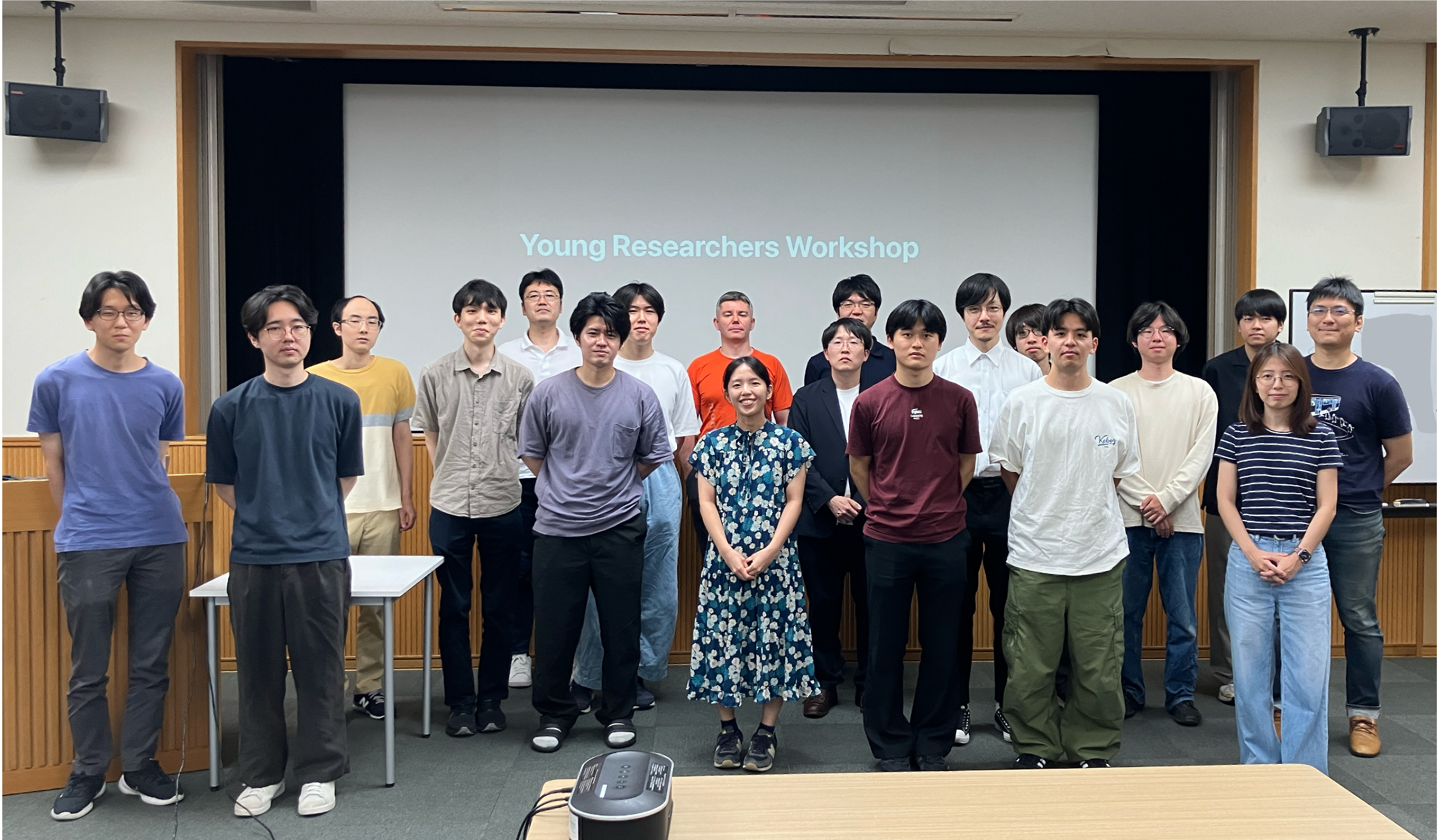
The two-day workshop has successfully concluded.
Thank you very much for your participation!

Please complete the survey by July 23.
https://forms.gle/gy28AKHxZAQyZodm9

Purpose

The workshop is dedicated to establishing the interconnections between young researchers from different research groups and fields at ICRR.

Style

This year's workshop is held at the Kashiwa campus, and in-person participation is preferred in order to have fruitful discussion.

Remote connection can be setup if necessary. Please let us know whether you attend the workshop onsite or online in your registration process. The Zoom link is below.

Zoom link: https://u-tokyo-ac-jp.zoom.us/j/86181338028?pwd=iusayO8JklhEEpDtKrHFm3qGKmM95Y.1

Meeting ID: 861 8133 8028

Passcode: 122139

※Please do not share this link publicly.

Banquet

Although there will be no banquet, you are welcome to join the ICRR Summer Party on July 16 if you're interested. If you are willing to join the party but didn't pay for the party yet, please contact the recreation committee (Seiya Nozaki: nozaki@icrr.u-tokyo.ac.jp).


Registration

You can make your registration process from the bottom of this page. Please complete your registration if you join this workshop.

Target

Postdocs, project assistant professors, assistant professors, and students.

Observer

Faculty members.

Participants
  • Chiaki Hirose
  • Chisato Koyama
  • Futatsu Sugimoto
  • Ginga Imaizumi
  • Habib Ahammad Mondal
  • Heungsu SHIN
  • Hideyuki Tagoshi
  • Hiroki Asuke
  • Hiroto Yanagisawa
  • Ievgen Vovk
  • Jun Miyamoto
  • Kai Morita
  • Kana Takechi
  • Kazuya Kobayashi
  • Kento Imai
  • Kin Hang (Paul) YEUNG
  • Kota Nakagiri
  • Kotaro Otsuzuki
  • Kyosuke Okamura
  • Mahiro Sato
  • Marcel Strzys
  • Masahiro TAKEDA
  • Masayuki Harada
  • Mitsunari Takahashi
  • Motoki Suzuki
  • nanaki itakura
  • Naohiro Osamura
  • Naomi Tsuji
  • Naru Tamaki
  • Ryo Higuchi
  • Ryosei Yaguchi
  • Ryosuke Kobashi
  • Shinji Miyoki
  • Shinnosuke SATO
  • Shoichi Oshino
  • Shotaro IEYASU
  • Shun Saito
  • Shuoyu Chen
  • Sogo Ito
  • Takaaki Yokozawa
  • Takafumi Ushiba
  • Takayuki Saito
  • Takuya Tashiro
  • Tzu-Han Hung
  • Xubin Wang
  • Yasuhiro Murakami
  • Yuji Yamanaka
  • Yuta Kageura
  • Yuta Tange
  • Yuto Ichinose
  • ZHIPENG ZHANG
  • Wednesday, 15 July
    • 09:50 10:00
      Opening
      Convener: chiaki hirose
    • 10:00 11:00
      Session 1: Telescope array
      Convener: Chenghao Zhu
      • 10:00
        Ultra-High-Energy Cosmic Rays and the Telescope Array Experiment 45m

        The year 1912 marked the beginning of modern astroparticle physics, when Victor Hess discovered penetrating radiation of extraterrestrial origin. Since then, the energy frontier of cosmic rays has steadily expanded. In 1962, a primary cosmic ray with an energy of about 100 EeV was observed for the first time. However, more than 60 years after that observation, many fundamental questions about ultra-high-energy cosmic rays remain unresolved.

        As part of the effort to address these questions, the Telescope Array (TA) experiment was established as an international collaboration in which Japanese universities and research institutes, including the Institute for Cosmic Ray Research, have played an important role. Since 2008, TA has been observing ultra-high-energy cosmic rays as the largest ultra-high-energy cosmic-ray observatory in the Northern Hemisphere. In recent years, its extension project, TA×4, has been deployed to increase the exposure at the highest energies.

        In this talk, I will first review the history of ultra-high-energy cosmic-ray observations, and then present recent results from the TA experiment. Finally, I will briefly introduce proposed next-generation ultra-high-energy cosmic-ray observatories, such as GCOS.

        Speaker: Heungsu Shin
      • 10:45
        Discussion 15m
    • 11:00 11:20
      Coffee break 20m
    • 11:20 12:20
      Session 2: Tibet-ASγ/ ALPACA
      Convener: Heungsu Shin
      • 11:20
        Recent Results from the Tibet ASγ Experiment: Gamma-Ray Observations and a Related Study on Cosmic-Ray Composition 30m

        This presentation introduces three recent peer-reviewed papers related to the Tibet ASγ experiment published in 2025–2026. The first presents a study of the ultra-high-energy γ-ray halo surrounding the Geminga pulsar, providing new constraints on the magnetohydrodynamic turbulence around the source. The second demonstrates the experimental verification of a convolutional neural network (CNN)-based gamma/hadron separation method for TeV gamma-ray observations. The third reports a Monte Carlo simulation study of elemental cosmic-ray energy spectra using the Tibet Air-Shower and Muon Detector Arrays with the Bayesian unfolding method, demonstrating the feasibility of elemental spectrum reconstruction around the knee region.

        Speaker: Ginga Imaizumi (ginga@icrr.u-tokyo.ac.jp)
      • 11:50
        Review on Recent Progress and Status of the ALPACA Experiment 30m

        Andes Large area PArticle detector for Cosmic ray physics and Astronomy (ALPACA) experiment is a planned extensive air shower experiment aiming for very high energy gamma ray sources in the southern sky. The full array will combine surface detector array with underground muon detector for gamma / hadron discrimination. Currently the prototype, ALPAQUITA surface array has been constructed and is operating since April 2023. In this brief talk, I will introduce the scientific motivation, detector concept and current status of underground muon detector construction with emphasis on cosmic-ray observation results obtained with prototype array.

        Speaker: Futatsu Sugimoto (ICRR)
    • 12:20 13:50
      Lunch Break (Free discussion encouraged) 1h 30m
    • 13:50 14:50
      Session 3: CTA
      Convener: Ryo Higuchi
      • 13:50
        CTA group general talk 15m

        Cherenkov Telescope Array Observatory (CTAO) is the next-generation very-high-energy gamma-ray observatory. Our group has been contributing to the commissioning of the telescopes since years. In this presentation, we report activities of our group and the status of the CTAO commissioning and construction.

        Speaker: Seiya Nozaki (ICRR)
      • 14:05
        Flash talks on their research 36m

        In this sub-session, we will have flash talks on their own topics by young researchers. If you want to discuss with them, please feel free to contact them during the coffee break!

        Nanaki Itakura (M1): WaCoT & NGC1068 review
        Kai Morita (M2): VHE Gamma-Ray Observations of the PeVatron Candidate V4641 Sgr with LST-1
        Sogo Ito (M2): Systematic Uncertainties in Flux Estimation for Large-Zenith-Angle Observations with LST-1
        Habib Mondal (postdoc): Pushing the Horizon: Flat Spectrum Radio Quasars with LST-1
        Zhipeng Zhang (postdoc): From LACT to LST
        Mitsunari Takahashi (project assistant professor): How should we record research with self-made software?

        Speakers: Habib Ahammad Mondal, Kai Morita, Mitsunari Takahashi, Nanaki Iwakura, Sogo Ito (Nagoya University), ZHIPENG ZHANG
      • 14:41
        Discussion 9m
    • 14:50 16:00
      Session 4: Neutrino / Nucleon Decay / Dark Matter
      Convener: Heungsu Shin
      • 14:50
        Neutrino Physics with Super-Kamiokande and Hyper-Kamiokande: Recent Progress and Future Prospects 23m

        This talk will review recent progress in Super-Kamiokande neutrino research, including oscillation measurements, low-energy neutrino studies and supernova neutrino searches. It will also discuss the current status of Hyper-Kamiokande and its physics goals in neutrino related field.

        Speaker: Xubin Wang
      • 15:13
        Status and prospects of the nucleon decay search in Super-Kamiokande and Hyper-Kamiokande 23m

        Nucleon decay is a key prediction of grand unified theories (GUTs) and would provide direct evidence for physics beyond the Standard Model. Extensive searches have been conducted by experiments such as Kamiokande and Super-Kamiokande. This presentation reviews the current status of nucleon decay searches and discusses future prospects with the upcoming Hyper-Kamiokande experiment.

        Speaker: Takuya Tashiro
      • 15:36
        An Overview of the XENONnT Experiment 23m

        The XENONnT experiment is one of the world's most sensitive direct dark matter search experiments, employing a dual-phase liquid xenon time projection chamber to search for rare interactions between dark matter particles and xenon nuclei.
        In this talk, I will introduce the scientific motivation, detector design, detection principle, and recent physics results of the XENONnT experiment

        Speaker: Kotaro Otsuzuki (Kamioka, ICRR)
    • 16:00 16:20
      Coffee break 20m
    • 16:20 17:20
      Session 5: Obs. Cosmology
      Convener: Masayuki Harada
      • 16:20
        Cosmic Reionization and Cosmological Parameters 15m

        JWST observations of high-redshift galaxies have greatly advanced our understanding of cosmic reionization. Since reionization affects the CMB, I will present our recent results on constraining cosmological parameters using these galaxy observations.

        Speaker: Yuta Kageura
      • 16:35
        A Scaling Relation of “Little Red Dots” between Halpha and Bolometric Luminosities: Enhanced Halpha Emission Relative to Low-z Type 1 AGNs 15m

        We investigate the spectroscopic demography of “little red dots” (LRDs) using 37 objects at z~3–7 compiled from various JWST programs. We identifiy a tight scaling relation between Ha luminosity (L_Ha) and bolometric luminosity (L_bol), which is enhanced by a factor of ~40 in L _Ha relative to that of low-z type 1 AGN. We explore the physical origin of this enhancement based on the classic locally optimally-emitting cloud (LOC) framework, and find that it can be explained by an increase in the broad line region (BLR) covering factor from ~20% (Type 1 AGN) to ~100% (LRDs), together with an increase in the hydrogen column density from N_H~10^23 cm−2 to >10^24 cm−2.

        Speaker: Hiroto Yanagisawa
      • 16:50
        Early Chemical Enrichment in UV-Bright Galaxies at the Epoch of Reionization Probed by JWST Absorption-Line Analysis 15m

        Using JWST/NIRSpec medium-resolution spectra of UV-bright
        galaxies at z=7.2-10.6, we investigate interstellar absorption lines to
        probe the physical properties of mostly neutral gas and the early
        chemical enrichment of galaxies during the epoch of reionization.

        Speaker: Minami Nakane
      • 17:05
        Statistical Rethinking: overmassive blackhole at high-z universe 15m

        We will present a statistical rethinking of the phenomenon that the AGN in the high-z universe tends to have overmassive black holes. The result will be revisited in the aspect of both more stable statistical index and more sources.

        Speaker: Chenghao Zhu
    • 17:20 18:20
      Session 6: Gravitational wave
      Convener: Chenghao Zhu
      • 17:20
        The current status of the gravitational wave detector KAGRA 20m

        KAGRA is a 3 km cryogenic, underground laser interferometric
        gravitational-wave detector in Kamioka, Japan, and a member of the
        international LIGO–Virgo–KAGRA network. This talk reviews KAGRA's
        performance and contribution during the fourth observing run (O4).

        Speaker: Shoichi Oshino (ICRR)
      • 17:40
        Direct Wave and Review of gravitational wave data analysis 20m

        Gravitational waves emitted as a binary black hole merges and settles into a stationary state are called ringdown gravitational waves, which provide key clues to exploring the nature of strong gravity. These waves are conventionally modeled by a superposition of damped oscillations known as quasi-normal modes (QNMs). Recently, the potential contribution of a "direct wave" component has been debated, but its mechanism remains largely unknown. We clarify this mechanism through an analysis based on black hole perturbation theory. Furthermore, we review recent studies from gravitational wave data analysis groups.

        Speaker: Keiichiro Kubota
      • 18:00
        Robust Inference of the Binary Black Hole Spin Population Using Gravitational-Wave Data 20m

        The spin population of binary black holes (BBHs) provides key insights into their formation channels. Recent gravitational-wave (GW) observations have suggested the presence of spin subpopulations and correlations between spin and other BBH parameters. However, the limited measurability of spins in certain regions of the parameter space can bias the inference of the underlying spin population. We propose a new inference method to mitigate this limitation, demonstrate its performance using simulations, and apply it to real GW data to infer the underlying BBH spin population.

        Speaker: Kazuya Kobayashi
    • 18:20 18:30
      Wrap-up of Day 1 &announcements for Day 2
    • 09:50 10:50
      Session 7: High energy astrophysics
      Convener: Naohiro Osamura
      • 09:50
        Cosmic-Ray Acceleration on supernova remnant shocks 30m

        Supernova remnants (SNRs) have been considered as the sources of the bulk of Galactic cosmic-ray (CR). Recently some evidences of extended gamma-ray emission are reported by e.g. LHAASO and H.E.S.S. and this emission infers the existence of particles escaping from accelerating region of SNRs.
        In this work, we solve one-dimensional diffusion-convection equation coupled with analytical solutions for shock dynamics, to obtain the time evolution of phase-space distribution function of CR. As a result, the time evolution of CR acceleration still increases even after the age of 10kyrs in our models, and this behavior is largely affected by environment of SNRs.

        Speaker: Ryosuke Kobashi
      • 10:20
        Cosmic-Ray Transport in Interstellar Medium 30m

        Cosmic rays are a key probe of high-energy astrophysical phenomena across a broad wavelength range, from radio to gamma rays, and may also play an important role in regulating galaxy evolution. However, how cosmic rays are transported in and around galaxies, and how they feed back on gas and magnetic fields, remain poorly understood. To investigate these two aspects of cosmic rays in a unified framework, we are developing a numerical code that treats cosmic-ray transport and dynamical feedback self-consistently. Recent improvements to the code have enabled us to stably follow the long-term evolution of star-formation-driven winds interacting with cold gas clouds under more realistic physical conditions. In this talk, I will present an overview of the code and discuss numerical results on how cosmic-ray transport affects the dynamical evolution of cold gas clouds in the galactic halo.

        Speaker: Ryohei Inamoto
    • 10:50 11:20
      Coffee break 30m
    • 11:20 12:20
      Session 8: Theory group
      Convener: Ryosuke Kobashi
      • 11:20
        Evanescent operator contribution to radiative correction to QCD theta parameter at two-loop level in the BMHV scheme 20m

        This talk studies a three-loop contribution to the electron EDM induced by CP-violating Yukawa couplings of new $SU(2)_L$ multiplets.
        These couplings generate the electroweak Weinberg operator at two loops, whose one-loop insertion can yield an electron EDM larger than the SM contribution even for TeV-scale new particles.
        The paper also compares this three-loop effect with the usual two-loop Barr–Zee contribution when the SM Higgs has new Yukawa interactions.

        Speaker: Naohiro Osamura
      • 11:40
        Cosmic String in Multi-step Symmetry Breaking 20m

        Cosmic strings are promising sources of a stochastic gravitational wave background that can be probed by pulsar timing arrays and future interferometers. In this talk, I discuss metastable cosmic strings formed through multi-step symmetry breaking, focusing on their internal structure and its implications for gravitational wave observation.

        Speaker: Aken Bun
      • 12:00
        Thermal leptogenesis における reheating temperature のベイズ推定 20m

        本発表では、type-I seesaw模型に基づく熱的レプトジェネシスにおいて、再加熱温度の自然性をベイズ推論により評価する。ニュートリノ振動データと宇宙のバリオン非対称性を同時に課すことで、成功するレプトジェネシスが単に可能かではなく、パラメータ空間でどれほど典型的かを定量化する。

        Speaker: Shotaro Ieyasu
    • 12:20 12:50
      Wrap-up of ICRR YRW 2026 / photo session
      Convener: Chiaki Hirose